Why Is Battery Lifecycle Management Important for Manufacturers?

safekt
October 13, 2026
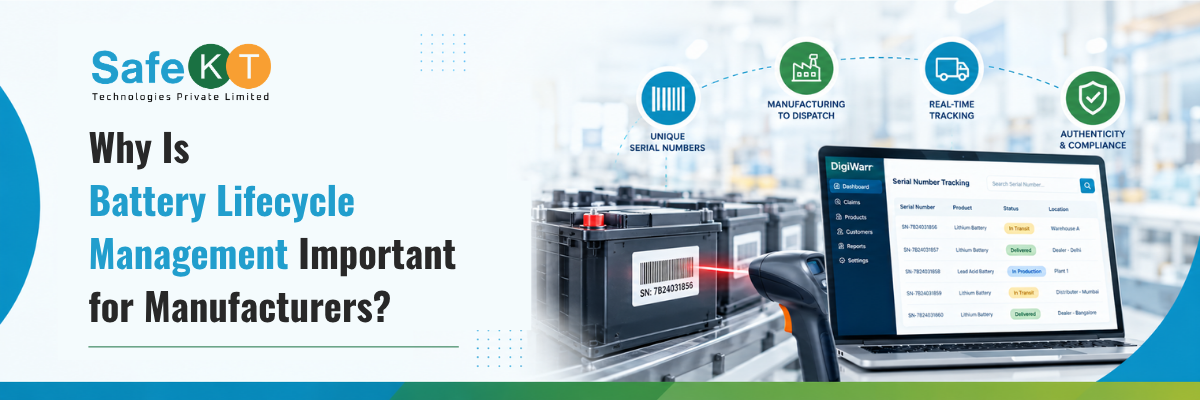
A dealer calls to report a battery that failed far too early, and Kavita, who heads quality at a battery manufacturing unit near Ahmedabad, needs three answers quickly. Which batch was it from, where did it travel after leaving the plant, and is it still under warranty? The answers exist somewhere, spread across a production register, a dispatch file, and a dealer’s invoice book. This is the everyday gap that battery lifecycle management closes, and the first step towards closing it is smaller than most manufacturers expect.
Battery lifecycle management means following a battery from the day it is made to the day it is retired and keeping one usable record of everything that happens in between. That record covers the batch it came from, the warehouses and dealers it passed through, the customer who bought it, any service visit and, eventually, the recycling stage. Kavita is an imaginary example, but her problem is a real one, because each piece of this information sits with a different person.
Table of Contents
ToggleIt also helps to separate this from the battery management system inside the pack itself. That system watches cell voltage and temperature while the battery is working, which is useful, but it does not record where the battery was sold or when its warranty began. Lifecycle management covers the business side of the battery life.
Without battery lifecycle tracking, every decision about quality and service rests on memory and guesswork. When a complaint arrives, the team cannot tell if it is a one-off or the first sign of a batch problem, so they either react too strongly or miss the signal until more complaints follow. Tracking gives each battery a known start date, route and history, which means replacements are approved on facts rather than goodwill.
Regulation is nudging manufacturers in the same way. India’s Battery Waste Management Rules, 2022 cover electric vehicle, portable, automotive and industrial batteries, and they make producers responsible for collecting and recycling waste batteries. That responsibility is hard to meet when you cannot say where your batteries ended up.
Visibility simply means knowing where a battery is and who is responsible for it right now. In Kavita’s plant, a battery leaves the warehouse, and the trail goes quiet until a customer calls. With battery product tracking, each unit carries a serial number that is scanned at the key points of its journey, so the plant can see stock sitting with distributors, models that sell slowly, and units that moved without any record.
Battery tracking software keeps those scans in one place. A question such as how many units of a particular model are still with dealers in Gujarat then stops being a round of phone calls and becomes a quick search.
Warranty looks like a separate department’s job, yet every warranty decision depends on lifecycle facts. The warranty period normally starts on the sale date, and that date exists only if somebody recorded the sale. When a claim comes in, the team has to confirm the serial number, the sale date, the dealer, and any earlier service on that battery. If those facts are scattered, claims are either approved in a hurry to avoid an argument or delayed while someone hunts for papers.
Good battery warranty management reads from the same lifecycle record, so decisions are consistent and quicker. It also shows finance what a warranty really costs, by model and by batch, instead of a single yearly figure.
Start with what actually happens to a battery. It is produced, tested, stored, dispatched, received by a distributor, sold through a dealer, and sometimes serviced or replaced. Each step is an event, and a useful history is just those events recorded in order against one serial number. Recording every possible detail from day one often becomes heavy for the team, so it is easier to begin with the handful that matter most, usually production, dispatch, dealer receipt, sale and service, and to capture each one when it happens rather than typing it up a week later.
This is the work that battery lifecycle tracking software takes over. It attaches each event to the serial number as it happens.
Once histories exist, patterns begin to show. Suppose complaints about one model keep coming from the same region. Looking at the lifecycle data, Kavita notices that most of the failed batteries share a production week, and many waited a long time in storage before they were sold. That points towards a batch or storage issue rather than a design fault, and the response changes accordingly.
Without that data, the usual outcome is a vague quality alert and a slow debate between production, logistics, and service. Lifecycle data cannot tell you why a battery failed, but it narrows the search, so engineers look at the right batch first. Has your team ever spent a week looking at the wrong cause because nobody could say which batch to examine?
Battery traceability is the ability to follow a battery backwards to its batch and forwards to its customer, and it matters most on the day when something goes wrong. If a defect is found in one batch, a manufacturer with good traceability can contact the dealers and owners who actually received those units, instead of treating every battery of that model as suspect. That saves money and protects customer trust.
Rules abroad are moving in the same direction. Under the EU Battery Regulation, electric vehicle batteries, light means of transport batteries and industrial batteries above 2 kWh need a digital battery passport from 18 February 2027, accessed through a QR code. Manufacturers that export, or plan to, will find compliance far easier if their records are already organised by serial number.
Registers and spreadsheets can hold a lifecycle record for a while, but they depend on people to keep them current, and they fall behind as volumes grow. Battery lifecycle management software keeps each battery’s history in one place and links production, dispatch, sale, warranty and service to its serial number. Good battery management software of this kind also shows trends by batch, model, and dealer, which is what turns scattered records into decisions.
Software will not repair a process that nobody has agreed on, though. The first job is to decide which events to capture, who records them and what the business wants to learn from the data, and an outside view can save a lot of time at that stage. If your team still answers battery questions by calling around, SafeKT can help you map your current lifecycle, find where the records break, and choose a practical way to run battery lifecycle tracking that suits how you work. Then the next call from a dealer becomes a quick lookup instead of an investigation.
Tracking replaces guesswork with facts. It shows where each battery is, when its warranty began and how similar units are performing, so manufacturers can spot batch problems early, settle claims fairly and answer dealer or regulator questions without searching through scattered records.
Tags :
Get complete visibility across your battery lifecycle with smarter warranty management, automated claims, real-time tracking, and powerful business insights.

Copyright © 2026 All rights reserved.