Why Is Battery Lifecycle Management Important for Manufacturers?

safekt
October 5, 2026
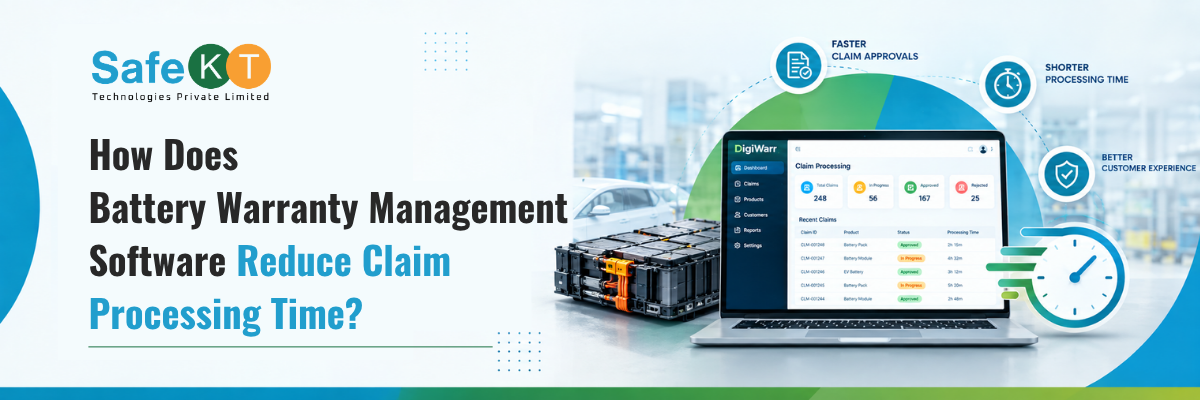
It’s the third call this week from the same dealer in Rajkot. A customer’s inverter battery failed under warranty; the replacement still hasn’t been approved, and the claim is sitting somewhere between an email inbox, a WhatsApp chat and a spreadsheet nobody has opened since Monday. For many battery manufacturers, this is a normal week. Most of the delay comes from a few predictable gaps, and battery warranty management software is built to close them.
Picture a medium sized battery manufacturer in Ahmedabad that sells inverter and electric rickshaw batteries through dealers across Gujarat. It’s a hypothetical example, but anyone in the battery trade will recognise it. When a battery fails in Rajkot, the dealer, Mehul, sends a few photos on WhatsApp along with a handwritten warranty card. The service desk gets the details two days later, cannot read the serial number clearly and asks for a better picture. Someone then checks the dispatch register to confirm the sale date. If it doesn’t match the card, the questions start all over again.
Table of Contents
ToggleNone of these steps takes long on their own. The time disappears in the waiting between them, and three weeks can pass before the customer gets a replacement.
How many of your open battery warranty claims are waiting on information someone in the chain already has? That is usually where warranty claim processing slows down.
Before looking at the features, it helps to understand why more manufacturers are asking this question now.
More batteries in the field means more claims to handle. According to the IEA’s Global EV Outlook 2026, global electric car sales grew by 20% in 2025, passing 20 million. India has its own strong growth story, with the India Energy Storage Alliance reporting 2.55 million EV sales in the 2025 to 2026 financial year, a 25% year-on-year increase. Regulation is moving too. Under India’s Battery Waste Management Rules, 2022, producers must register with the Central Pollution Control Board and are responsible for collecting and recycling or refurbishing waste batteries. When producers carry responsibility for a battery across its life, clear records for each unit become far more valuable.
In simple terms, a battery warranty system gives every claim one clear path. The dealer raises the claim digitally, the system checks warranty status against stored records, the claim goes to the right person for approval, and everyone can see its progress until it’s closed. That is the core of digital warranty management, and each part of it removes a specific delay from the Rajkot story.
The first delay starts at the dealer’s counter, so that’s where the fix begins. With digital submission, the dealer fills in a short form that asks for the serial number, invoice, customer details, and photos of the failed battery. Required fields can’t be skipped, so a half-complete claim never reaches the service desk.
This matters because incomplete claims cause most of the back and forth, and they consume a lot of time. A simple photo guide, showing the label and terminals clearly, helps dealers get it right the first time. When Mehul submits his next claim this way, the service team has everything on the same day, and nobody needs to chase him for a missing invoice. This makes his claim and the other claims much simpler.
A complete claim still has to be checked. In a manual setup, someone opens registers, confirms the warranty period for that model, reads through the terms, and two staff members may still reach different answers.
Automated verification does this check on its own. The manufacturer defines the warranty rules once, such as coverage periods for each battery type and the conditions that apply. The battery warranty software then applies those rules to every claim in the same way. Clear cases move ahead immediately, while unusual ones are flagged for a person to review. For the Rajkot battery warranty status is confirmed within minutes. This is how automated warranty claims save time while leaving judgment with your team where it’s needed.
Verification only works well when the system knows exactly which battery it’s looking at. Serial number tracking links each battery to its manufacturing batch, dispatch date, dealer, and date of sale. As soon as someone enters the number, the battery’s full history appears.
This protects both the manufacturer and the customer. A genuine battery is confirmed quickly, a serial number that shows up in two claims or one that was never sent to that dealer, gets flagged before a replacement goes out, and the practical step is to capture serials at dispatch and again at the point of sale using barcode or QR scans where possible. Reliable battery claim management depends on this record and so does sound battery warranty management. Both of them are a crucial part of the process, and with constant tracking, the generated data can be used in quality control as well.
Even with quick checks, a claim can stall when its details are scattered. Sales keeps one spreadsheet; service keeps another, and dealers keep their own notes. The same information gets typed three times, and every update needs a phone call.
Centralised data puts everything into one shared record that sales, service, dealers and management can all see. Mehul can check his claim status himself, and the service head stops spending afternoons answering “any update?” calls. There’s a quieter benefit as well. Claim history no longer lives in the memory of one experienced service executive, so the knowledge stays with the business when that person goes on leave or moves on. That continuity is a big part of dependable warranty claim management.
Once claims flow through one system, they start revealing patterns. Analytics shows monthly claim volumes, how long each stage takes, which models fail more often, and which dealers raise the most claims. You can see where claims get stuck instead of guessing.
The stakes are worth noting; warranty Week’s 23rd Annual Product Warranty Report found that US based manufacturers together paid more than $30 billion in product warranty claims in 2025. Indian manufacturers work at a different scale, but the principle holds because every claim has a cost. In our example, a monthly report might show one production batch causing repeated battery warranty claims. Fixing that batch reduces future claims which shortens queues for everyone else.
Software helps, but how you introduce it matters just as much. A few practices make a clear difference.
Go back to the dealer in Rajkot. With a complete digital claim, automatic verification, a clear serial record and one shared view of progress, his customer’s replacement can be approved in days instead of weeks. Nobody rushed the decision. The waiting time between steps was simply taken out.
If your warranty claims still move through calls, emails and spreadsheets, it’s worth understanding where the delays actually happen before choosing a tool. SafeKT can help you map your current claim process, find the gaps and set up battery warranty management software in a way that works for your team and your dealers.
Tags :
Get complete visibility across your battery lifecycle with smarter warranty management, automated claims, real-time tracking, and powerful business insights.

Copyright © 2026 All rights reserved.