Why Is Battery Lifecycle Management Important for Manufacturers?
safekt
September 28, 2026
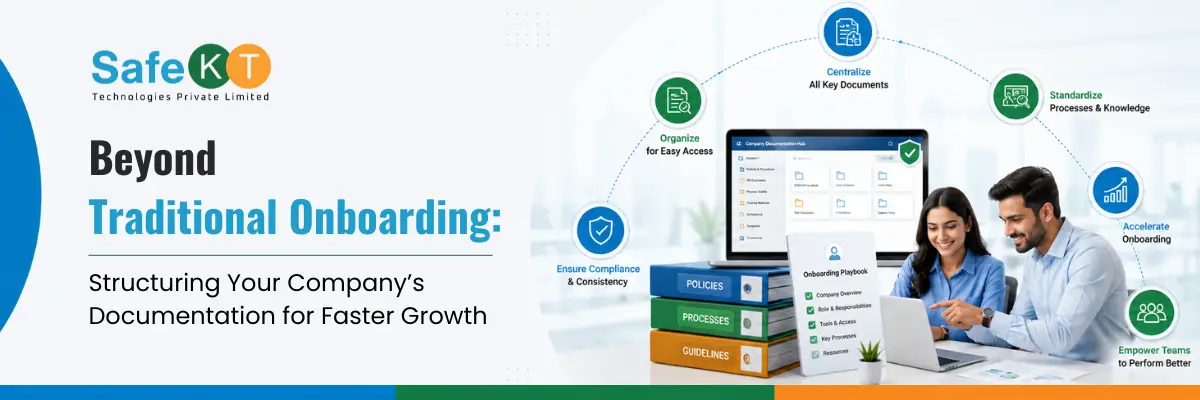
A new employee joins a growing company on a Monday morning ready to contribute, by Wednesday she has asked three different colleagues the same question about how a client process actually works and gotten three slightly different answers. Nobody wrote it down properly so everyone remembers it a little differently, this scene plays out in growing businesses across Ahmedabad and beyond every single week and it rarely gets fixed with a longer welcome email or a friendlier orientation session.
Most companies do not plan to run onboarding this way. It happens gradually. In the early days, a small team can rely on quick conversations and a founder who remembers everything. New hires learn by sitting next to someone experienced and asking questions as they come up. It works, mostly because the team is small enough that knowledge naturally moves around.
Table of Contents
ToggleThe trouble starts once the company grows. A handful of new hires each month means the same questions get repeated over and over and the answers depend entirely on who happens to be free that day, a printed handbook covers policies but says nothing about how a specific client is actually handled. A shared drive fills up with old files, some outdated, some duplicated and nobody is quite sure which version is current. This is exactly where employee onboarding solutions start to matter, not as a nice addition but as something that keeps the business functioning smoothly as it adds people faster than informal habits can support.
What happens to onboarding once the person who normally explains everything is out sick, travelling, or simply too busy?
Businesses are growing faster and hiring in shorter cycles than they used to, and new employees expect clarity from their first week rather than a slow trickle of information picked up by chance. This shift makes rapid onboarding strategies far more relevant than they were even a few years ago because a new hire who spends their first month figuring out basic processes is a month of reduced output the business cannot really afford.
The numbers back this up. According to SHRM, organisations with a standardised onboarding process see new hires become around 50% more productive and structured onboarding is linked to 69% of employees staying with the company for at least three years. Separate research points to roughly 62% greater productivity where onboarding is formal rather than left to chance, these are not small gains. They translate directly into faster ramp up time, fewer repeated questions and less pressure on senior staff who would otherwise be answering the same thing every week.
This is also where team knowledge sharing starts to matter as much as onboarding itself. A new hire is early weeks go smoothly not because someone is constantly available to help, but because the information they need already exists somewhere they can find it.
A corporate knowledge base is simply one place where company knowledge lives, instead of being spread across email threads, personal notes and half updated folders. Without it, businesses pay a real cost. Panopto’s Workplace Knowledge and Productivity Report, based on a survey of over a thousand US employees, found that people lose an average of 5.3 hours every week waiting for information or recreating knowledge that already exists somewhere in the company. The same research found that 42% of institutional knowledge is unique to the person holding it, meaning coworkers simply cannot complete that part of the job if that person is unavailable or leaves.
Building a centralised base does not mean starting from zero. It usually means gathering what already exists, retiring the outdated files, and giving someone clear ownership of keeping it current. Picture that same growing company pulling its scattered onboarding notes, client process guides and internal FAQs into one searchable space. The new hire from earlier finds her answer in minutes instead of asking around for two days.
A scalable documentation framework is what keeps a knowledge base useful as the company grows, rather than letting it turn into another pile of disorganised pages. This means consistent templates for how processes are written clear categories so people can find things by role or workflow and some form of version control so outdated instructions do not sit alongside current ones.
A company moving from twenty employees to sixty cannot rely on the same loose informal system that worked when everyone sat in one room documentation needs a structure sturdy enough to keep making sense as more teams and more processes get added to it.
Many businesses still keep their SOPs as static Word documents saved somewhere on a laptop. The problem is that these files are hard to search, easy to lose, and almost never updated once the person who wrote them moves on. Standard operating procedures software solves this by giving SOPs a proper home with search, access control and version history built in.
Digital SOP management also makes it possible to link procedures directly to the roles that use them, so a new hire in operations sees exactly what applies to their work rather than digging through unrelated files. Think of a process that used to live only in one senior employee’s head. Once it is documented properly, anyone on the team can follow it accurately, even if that employee is on leave or has since moved to a different role.
Good documentation is less about having more of it and more about organising what already exists so people can actually use it. A few internal documentation best practices worth following include,
The most common mistake growing businesses make is treating documentation as a one time project rather than an ongoing habit tied to how the company scales. Business scaling solutions work best when documentation grows alongside the team, not as an afterthought once things start feeling disorganised.
There is a direct connection between how well a company documents its processes and how confidently it can grow. A business that depends on a handful of people remembering everything will always struggle to expand quickly, because every new hire, every new location and every new client adds strain to a system that was never built to scale.
When knowledge sits in a centralised, well organised system instead, expansion feels less risky. New teams can be onboarded using the same reliable processes as the original team. Leadership spends less time answering repetitive questions and more time focused on decisions that actually need their attention. Panopto’s research also found that 85% of employees agree that preserving and sharing unique workplace knowledge is critical to productivity, which suggests most teams already sense this problem even before it is named out loud.
How much of your company’s most important knowledge currently exists only inside someone’s head?
Onboarding friction and scattered documentation are rarely just HR inconveniences. They are early signs of a business outgrowing its own informal systems. A process documentation system built with the right structure fixes both problems at once, helping new employees ramp up faster while giving the entire team a reliable place to find answers.
Picture that same growing company a year later. New hires now find what they need within their first few days, senior employees spend less time repeating themselves and expansion into new roles or locations feels far less chaotic than it once did.
If your business is reaching a stage where informal onboarding and scattered files are starting to slow things down, SafeKT can help you build a documentation and knowledge sharing system that keeps pace with your growth, without adding unnecessary complexity along the way.
Standard operating procedures software designed for search, version control and access management works far better than static documents saved in scattered folders. The right tool depends on team size and complexity, but the goal is always the same making procedures easy to find and simple to update.
Tags :
Get complete visibility across your battery lifecycle with smarter warranty management, automated claims, real-time tracking, and powerful business insights.
Copyright © 2026 All rights reserved.