Why Is Battery Lifecycle Management Important for Manufacturers?
safekt
September 3, 2026
For six years, one operations manager was the quiet reason a mid sized manufacturing company ran as smoothly as it did. She knew which vendors expected a phone call rather than an email which client accounts needed careful handling around payment terms, and which shortcuts in the production schedule actually worked even though nobody had ever signed off on them officially. None of it existed anywhere on paper. So when she resigned, her replacement inherited a laptop, a login and a two day handover that barely touched the surface of what the job really involved.
Three months later the company was still untangling the fallout. Deliveries kept slipping, the reason, nobody had access to the informal priority list she used to keep in her head a long standing client nearly walked away over a billing misunderstanding that she would have spotted and fixed in minutes the new manager was perfectly capable but capable is not the same thing as informed.
Table of Contents
ToggleThis is the part of employee turnover that rarely makes it into a resignation letter or an exit interview summary. The desk gets filled again fairly quickly. What takes far longer to rebuild is everything that person understood but never put into words.
Most businesses budget for the obvious costs of turnover. A new hire needs recruiting time, interviews, paperwork, and a few weeks of ramp up before they are fully productive. According to Gallup, replacing an employee typically costs between 50% and 200% of their annual salary, depending on the role and how senior it is. For a mid level manager, that is not a minor line item.
What rarely gets budgeted is the operational disruption that shows up after the new hire starts. This is where employee turnover risk mitigation becomes a real conversation rather than a policy on paper. The operations manager in our example did not just take her job title with her. She took years of accumulated judgment about how the business actually worked day to day which is a very different thing from what her job description said on paper.
This kind of loss is harder to quantify than a recruiting invoice but it shows up everywhere once you start looking. Slower decisions. Repeated mistakes that had already been solved once before a new hire who has to rebuild trust with clients and vendors from scratch. None of this appears on a balance sheet yet it affects every one of them.
Knowledge loss is not simply about missing files or outdated manuals. It is the gap left behind when someone’s experience judgment and informal know how leave the building with them a written process document can tell a new employee what to do. It rarely explains why an experienced person made a particular call under pressure or which exceptions to the rule actually matter.
This distinction matters more today because voluntary turnover has become a structural feature of most industries rather than an occasional disruption. Employees change jobs more often than they did a decade ago and businesses are having to rethink what knowledge retention strategies actually mean when tenure can no longer be assumed.
Research backs up how much of this knowledge is genuinely at risk. A widely cited Panopto and YouGov study found that around 42% of an employee’s job knowledge is unique to them and not shared with coworkers, meaning that when that person leaves, colleagues simply cannot perform a meaningful portion of their job without relearning it from scratch. The same study found that 85% of employees believe preserving and documenting unique workplace knowledge is important, yet most organisations still have no consistent way of doing it.
So the question worth sitting with is this. How much of your business currently depends on information that exists only inside one or two people’s heads?
Many companies respond to this gap by looking at operations management software as a way to bring structure to processes that used to live informally. That can help, but the software is only useful if the knowledge feeding into it is actually captured in the first place.
Key Pillars of an Effective Corporate Knowledge Transfer System
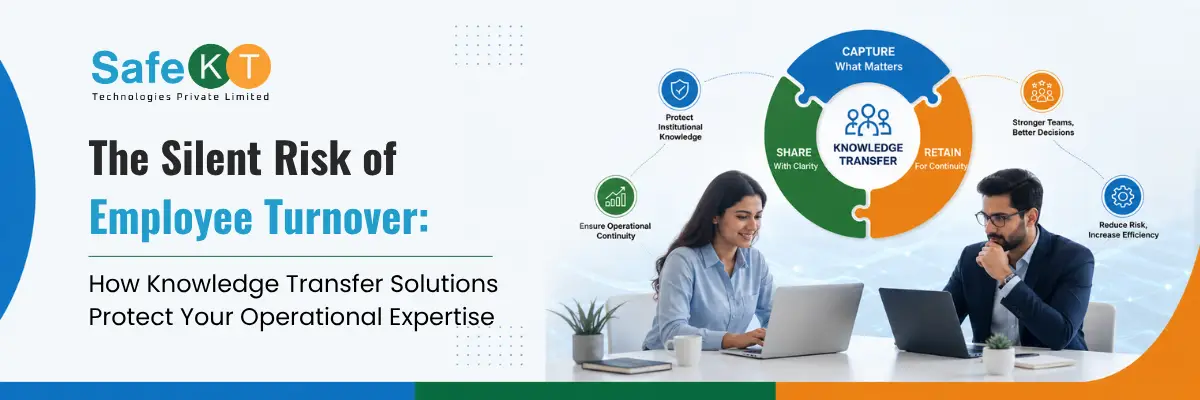
Solving this problem is not about writing one large manual and hoping it stays relevant. It works better as a system built around a few consistent habits.
Not every piece of information carries the same weight. Some knowledge is genuinely critical and would cause real disruption if it vanished overnight while other knowledge is simply useful and fairly easy to replace. The smarter first step is telling the two apart rather than trying to document everything at once and running out of steam halfway through.
A practical way to do this is to ask a simple question about each role. If this person left tomorrow with no notice what would the business struggle to do without them? In our operations manager’s case, the honest answer would have included her informal vendor relationships and her unwritten sense of which production shortcuts were safe to take.
Once critical knowledge is identified, it needs a consistent home. This is where business process documentation earns its place not as a bureaucratic exercise, but as a way of making sure that important processes do not live only in someone’s memory. A good standard operating procedures tool helps teams document steps in a format that is easy to update as processes change, rather than a static file that goes stale within months.
The goal here is not perfection. A clear, current SOP that covers eighty percent of a process is more useful than an exhaustive one that nobody keeps updated.
Most companies treat offboarding as an administrative task involving equipment returns and final paychecks. That is a missed opportunity. Offboarding best practices should include structured conversations where a departing employee walks through their responsibilities, flags anything unusual in their workload and answers questions before their last day rather than after it.
Had this existed for the operations manager someone would have asked her directly about vendor relationships and scheduling judgment calls before she walked out the door instead of discovering the gaps weeks later through client complaints.
Even good documentation loses its value if it is scattered across personal notebooks, old email threads, and someone’s private folder on a laptop that eventually gets reassigned. As teams grow this kind of fragmentation becomes a genuine liability rather than a minor inconvenience.
This is where internal knowledge base systems make a practical difference. A centralised system means that when someone needs an answer, they know where to look instead of having to track down whoever happens to remember. It also means new hires can find context on their own, rather than interrupting a busy colleague every time a question comes up.
Building this into a broader operational continuity plan turns documentation from a nice idea into something the business can actually rely on when people move roles, take leave, or resign. If a system like this had existed at the manufacturing company, the transition after the operations manager left would have looked very different. The new hire would have had somewhere to start instead of starting from zero.
None of this needs to be complicated to be effective. A few consistent habits go a long way.
These are not dramatic changes. They are habits that, applied consistently reduce how much any single departure can disrupt the business.
Employee turnover is not going away, and no business can eliminate it entirely. What a business can control is how much operational knowledge walks out the door when someone does leave. The gap between those two outcomes usually comes down to whether critical knowledge was ever captured in the first place.
If your organisation is losing important expertise every time an experienced employee resigns, SafeKT can help you identify where those risks exist and build a practical employee knowledge transfer process that fits how your business actually operates. Sometimes the most valuable conversation is simply figuring out what you do not yet have written down.
When new hires can find documented processes and context in one place, they spend less time waiting on colleagues or guessing at unwritten rules. This shortens the ramp up period considerably and reduces the number of repeated mistakes during a new employee’s first few months.
Tags :
Get complete visibility across your battery lifecycle with smarter warranty management, automated claims, real-time tracking, and powerful business insights.
Copyright © 2026 All rights reserved.